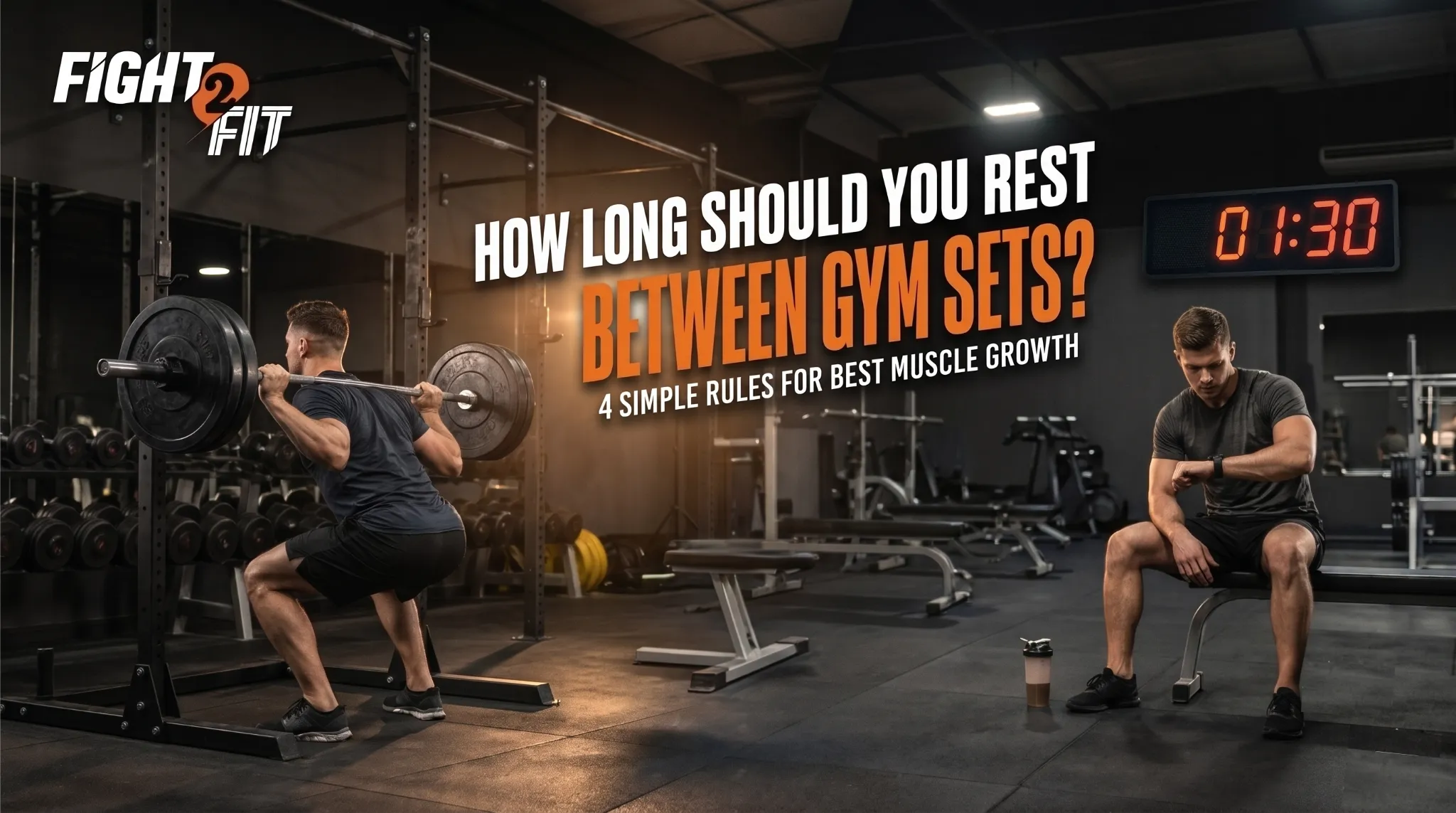
Walk into any gym today and you will notice two extreme habits when it comes to how long people rest between gym sets.
Most lifters accidentally fall into one of these two traps on the floor:
- The “No-Rest Marathon” Trap: You finish a set, take 15 seconds to catch your breath, and jump straight into the next set because you think non-stop sweating burns more fat. Within two sets, your muscles are exhausted and you are forced to lift lighter weights.
- The “Phone-Scroll” Trap: You open WhatsApp or Instagram between sets, get distracted, and accidentally sit on the bench for five minutes – letting your muscles cool down completely.
You do not need a complicated timer app to fix your training. Here is the practical guide to mastering your rest between gym sets so every workout builds real strength and lean muscle.
Rest Between Gym Sets: Quick Cheat Sheet by Goal
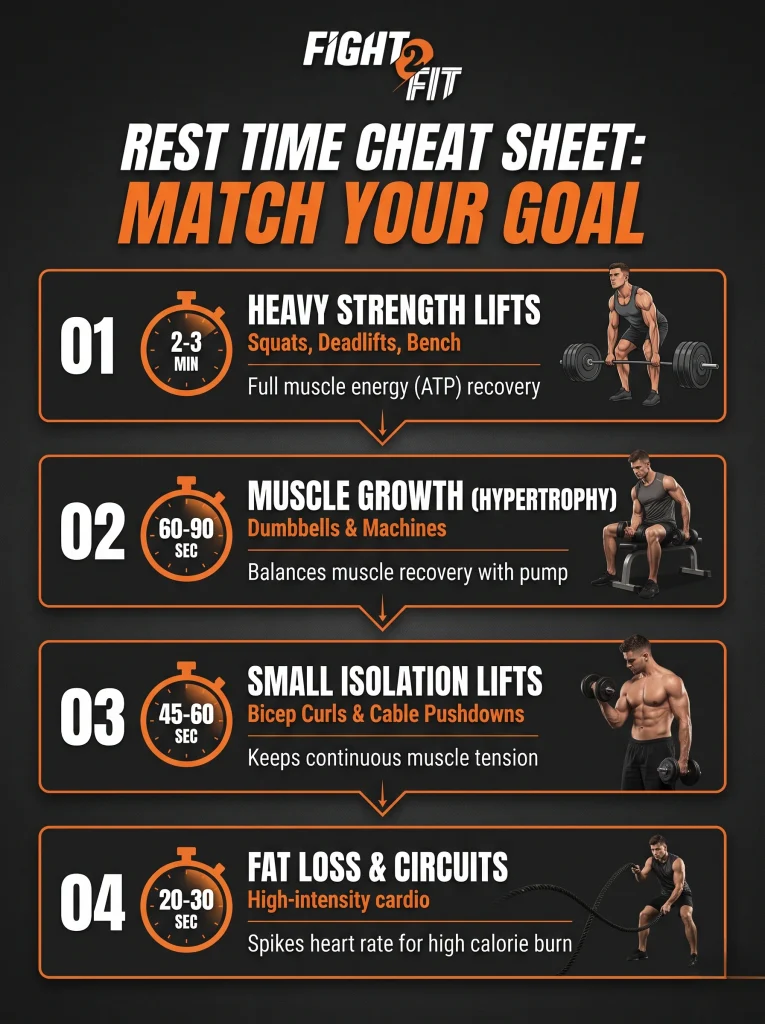
The ideal rest between gym sets depends entirely on the type of exercise you are performing and your fitness goal:
| Workout Goal & Exercise Type | Ideal Rest Time | Why This Timing Works Best |
| Heavy Strength Lifts (Squats, Deadlifts, Bench Press) | 2 to 3 Minutes | Fully restores muscle energy (ATP) so you can lift heavy safely |
| Muscle Growth / Hypertrophy (8–12 Reps on Machines & Dumbbells) | 60 to 90 Seconds | Balances muscle recovery with strong blood flow and pump |
| Small Isolation Lifts (Bicep Curls, Lateral Raises, Tricep Pushdowns) | 45 to 60 Seconds | Small muscles recover fast and respond best to continuous tension |
| Fat Loss & Conditioning Circuits | 20 to 30 Seconds | Keeps your heart rate elevated to maximize calorie burn |
4 Simple Rules for Rest Between Gym Sets
According to sports science studies on rest intervals, taking the right amount of recovery lets you lift heavier total weight across your workout—which is the #1 driver of muscle growth. Follow these four simple rules on your next gym session:
- Match Your Rest to the Weight on the Bar: Heavy compound exercises that work multiple joints (like squats, rows, and overhead presses) demand 2 to 3 minutes of recovery. Lighter single-joint exercises only need 45 to 60 seconds.
- Wait Until Your Breathing Steadies, Not Until You Feel Cold: You are ready for your next set the moment your heart rate slows down enough to speak a full sentence comfortably, while your target muscle still feels warm and pumped.
- Never Start a Set While Your Grip or Lower Back Is Shaking: If your core or forearms are still trembling from the previous set, take an extra 30 seconds. Rushing into heavy lifts with fatigued stabilizer muscles is the fastest way to get injured.
- Keep Your Phone Out of Your Hands: Nothing ruins your rest between gym sets faster than checking notifications. Use a simple wristwatch, wall clock, or gym timer so a 60-second break does not quietly turn into four minutes.
3 Real Gym Problems With Rest Timing (And How to Fix Them)
If your workouts feel exhausting yet your strength is not improving, poor rest between gym sets is usually the hidden culprit. Check these three common problems:
1. “I feel drained after my second set and have to reduce my weights.”
When you rush through heavy sets with only 30 seconds of rest, lactic acid builds up faster than your body can clear it. Increase your rest to a full 90 seconds or 2 minutes on your main compound exercises so you can hit all your target reps with the same heavy weight.
2. “My 45-minute workout stretches into 90 minutes without me realizing it.”
Long, untracked breaks kill workout intensity and waste your evening. Set a strict 60-to-90-second timer for your accessory exercises, and if you need personalized help structuring your workout pacing, our certified personal training programs keep every session focused, efficient, and tailored to your exact fitness level.
3. “I lose my muscle pump completely before my next set starts.”
Resting for three to four minutes on smaller exercises like cable flies, bicep curls, or calf raises lets blood flow leave the muscle. Keep your breaks between 45 and 60 seconds on isolation exercises to maintain constant tension and an unbeatable pump.
Active Rest vs. Sitting Still: What to Do Between Sets
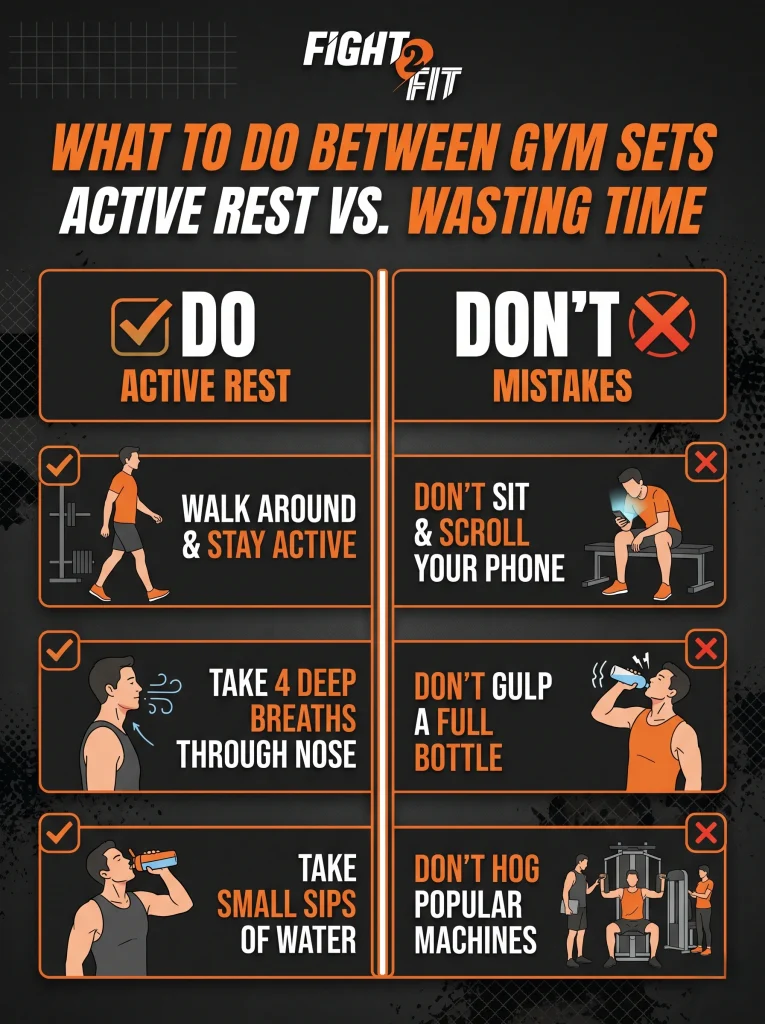
How you spend your rest between gym sets matters just as much as the clock:
| Common Gym Mistake | Smarter Gym Habit |
| Slumping forward on the bench looking down at your phone | Stand up, walk a few steps, and take 4 deep breaths through your nose |
| Gulping down a full bottle of water all at once | Take 2 small sips of water to stay hydrated without feeling heavy |
| Sitting on a popular machine for 3 minutes during peak hours | Step aside and offer to let others work in while you recover |
Frequently Asked Questions (FAQs)
1. Does resting longer between sets reduce fat loss?
No. Taking proper rest between gym sets actually helps fat loss because you recover enough to lift heavier weights and maintain higher workout intensity, which burns far more calories during and after your session than rushing with light weights.
2. Should gym beginners take more rest between sets?
Yes. Beginners should rest 90 seconds to 2 minutes between sets for their first few weeks. Extra recovery allows your heart rate to settle and ensures you perform every repetition with clean, injury-free form.
Conclusion: Rest Smart, Lift Stronger
Getting your rest between gym sets right is one of the easiest ways to break strength plateaus without changing your entire routine. Give your heavy lifts 2 to 3 minutes, keep isolation moves around 60 seconds, and stay off your phone until your final set is done.
Ready to train in an energetic environment with quality equipment and expert guidance? Explore our flexible Fight 2 Fit Gym membership plans and walk into Fight 2 Fit Gym today to build real strength and lasting results!